
James Webb Reveals Two Completely Different Twilights on Ultra-Hot World WASP-121b
JWST measured the dawn and dusk edges of a scorching gas giant 858 light-years away and found them wildly different in temperature and chemistry — the clearest evidence yet of an asymmetric exoplanet atmosphere.
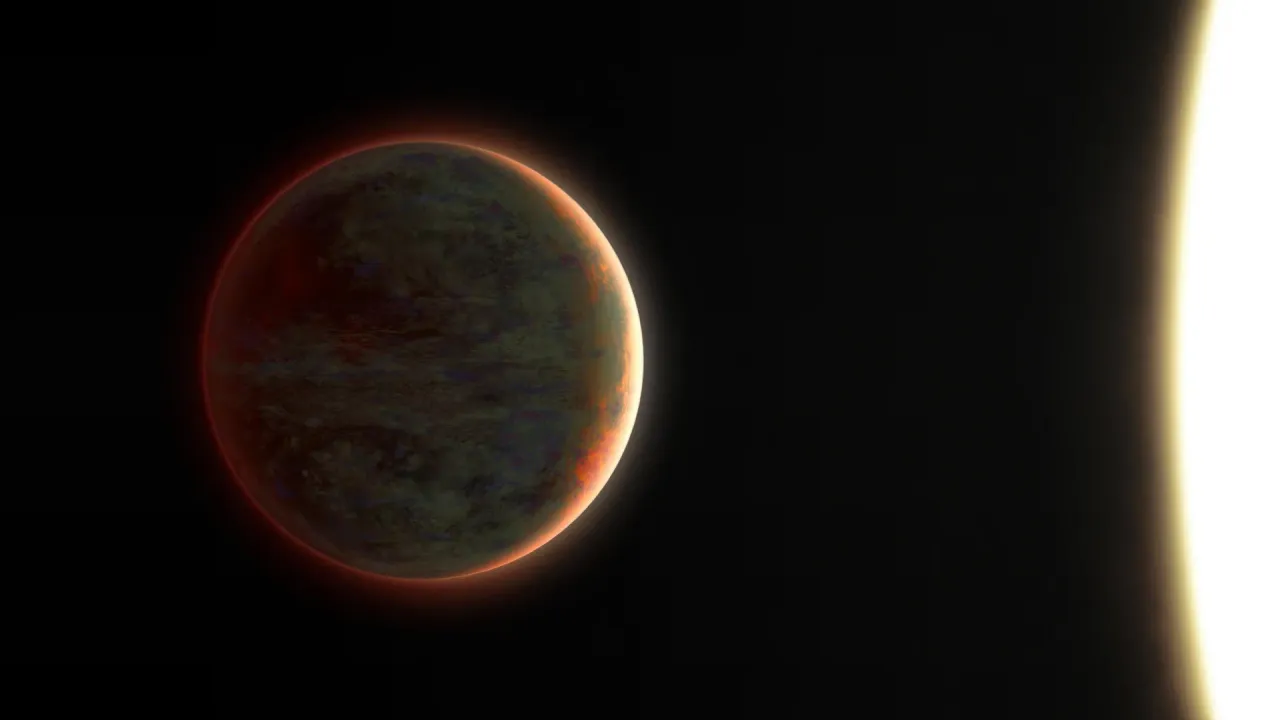
The James Webb Space Telescope has effectively read the weather on a world 858 light-years away — and found its morning and evening skies are nothing alike.
The short version
- JWST measured stark differences between the dawn and dusk edges of ultra-hot Jupiter WASP-121b (“Tylos”).
- The day side reaches about 2,770 K (~2,500°C) while the night side sits near 1,000 K.
- Fierce eastward winds drag heat around the planet, leaving the evening edge hotter and more puffed-up than the morning edge.
- Water molecules are torn apart on the dayside; possible silicate (mineral) clouds may shroud the cooler morning side.
- The study, led by Cyril Gapp of the Max Planck Institute for Astronomy, appears in Nature Astronomy.
How they did it
Rather than averaging the planet into a single measurement, the team used JWST’s NIRSpec instrument to track how starlight filtered through the atmosphere as the planet rotated roughly 30° during transit — effectively resolving its three-dimensional structure.
Why it matters
It is the clearest confirmation yet that hot-Jupiter atmospheres are deeply asymmetric, and it demonstrates a technique for mapping conditions across distant worlds rather than treating them as single dots of light.
Summary by Nerd News Network. Read the full article at ScienceDaily via the links above and below.