
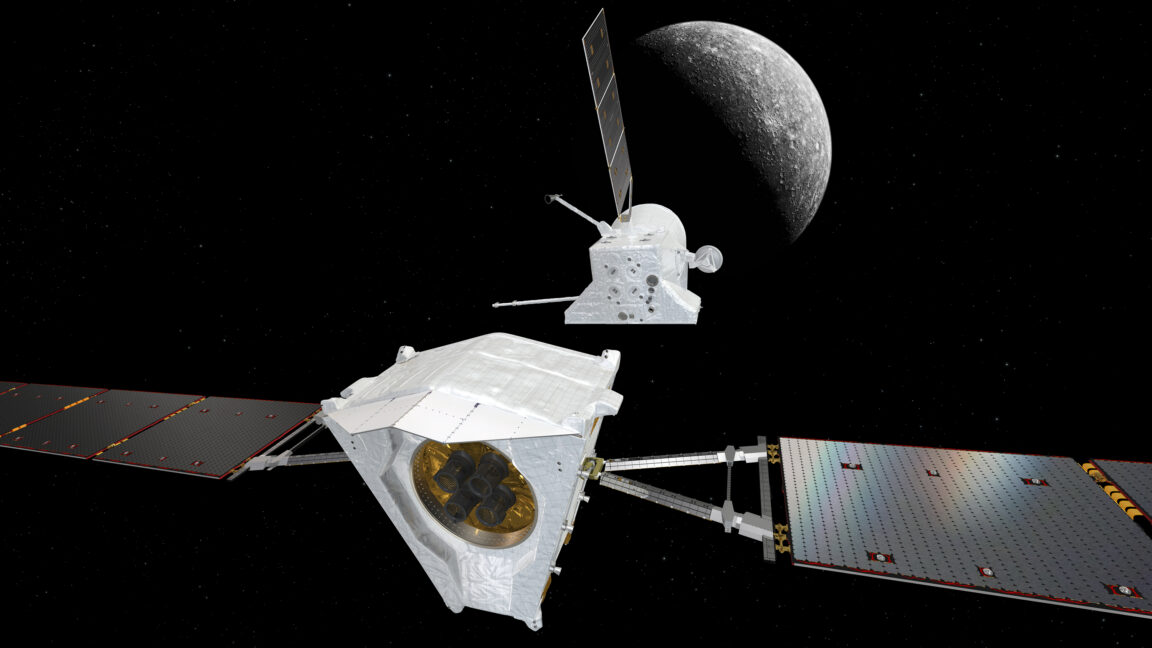
After 8 years, Europe's BepiColombo mission is on final approach to Mercury
"Fundamentally, we want to learn about the origins of this planet and how it came to be like it is.".
"Fundamentally, we want to learn about the origins of this planet and how it came to be like it is."
The short version
- The robotic science mission, with a price tag of nearly $2 billion, is led by the European Space Agency with contributions from Japan and the United States.
- Since its launch in 2018, BepiColombo has spiraled closer to the Sun using a combination of plasma propulsion and a series of flybys of Earth, Venus, and Mercury.
- The maneuvers changed the spacecraft’s velocity and steered it toward a final encounter with Mercury later this year.
What happened
Next time it reaches Mercury, BepiColombo will be traveling at just the right speed for the planet’s gravity to capture the spacecraft into orbit. Scientists working on interplanetary missions are accustomed to long waits for scientific payoffs.
Why it matters
It took nearly 10 years for NASA’s New Horizons spacecraft to travel from Earth to Pluto.
Summary by Nerd News Network. Read the full article at Ars Technica via the links above and below.